
The Sample Sale Industrial Complex
The luxury sample sale may be one of fashion’s most revealing contradictions.
The modern sample sale: part bargain hunt, part endurance test. Shoppers queue outside a New York designer sample sale in pursuit of luxury at less-than-luxury prices.
The origins of the sample sale were relatively practical. Fashion brands produced showroom samples, excess inventory accumulated, seasons changed, and unsold merchandise needed to be cleared. What began as a straightforward solution to an operational problem has gradually evolved into something far more culturally significant.
Today, sample sales occupy a curious space within the luxury ecosystem. They are commercial events, but they are also social experiences. In cities such as New York, Paris, London, and Milan, dedicated communities follow sale calendars with remarkable attention. Information circulates through newsletters, specialised platforms, private groups, and word of mouth. Organisers such as 260 Sample Sale, Arlettie, Showcase, and Milano Sample Sale have transformed what was once an industry necessity into a sophisticated business model of its own.
What makes the phenomenon particularly interesting is that the appeal often extends beyond the discount itself. Saving money is certainly part of the attraction, but it rarely explains the entire story. The modern sample sale offers something that luxury consumers value almost as much as the product: access.
Few examples illustrate this better than the sample sales associated with The Row. Reports regularly describe shoppers arriving before sunrise, queues stretching around city blocks, and even professional line-sitters being hired to secure a place. The commitment involved can seem disproportionate to the reward, especially when the reward is a discounted sweater or handbag. Yet that is precisely what makes the phenomenon so fascinating. The queue itself becomes part of the experience, transforming a transaction into a story.
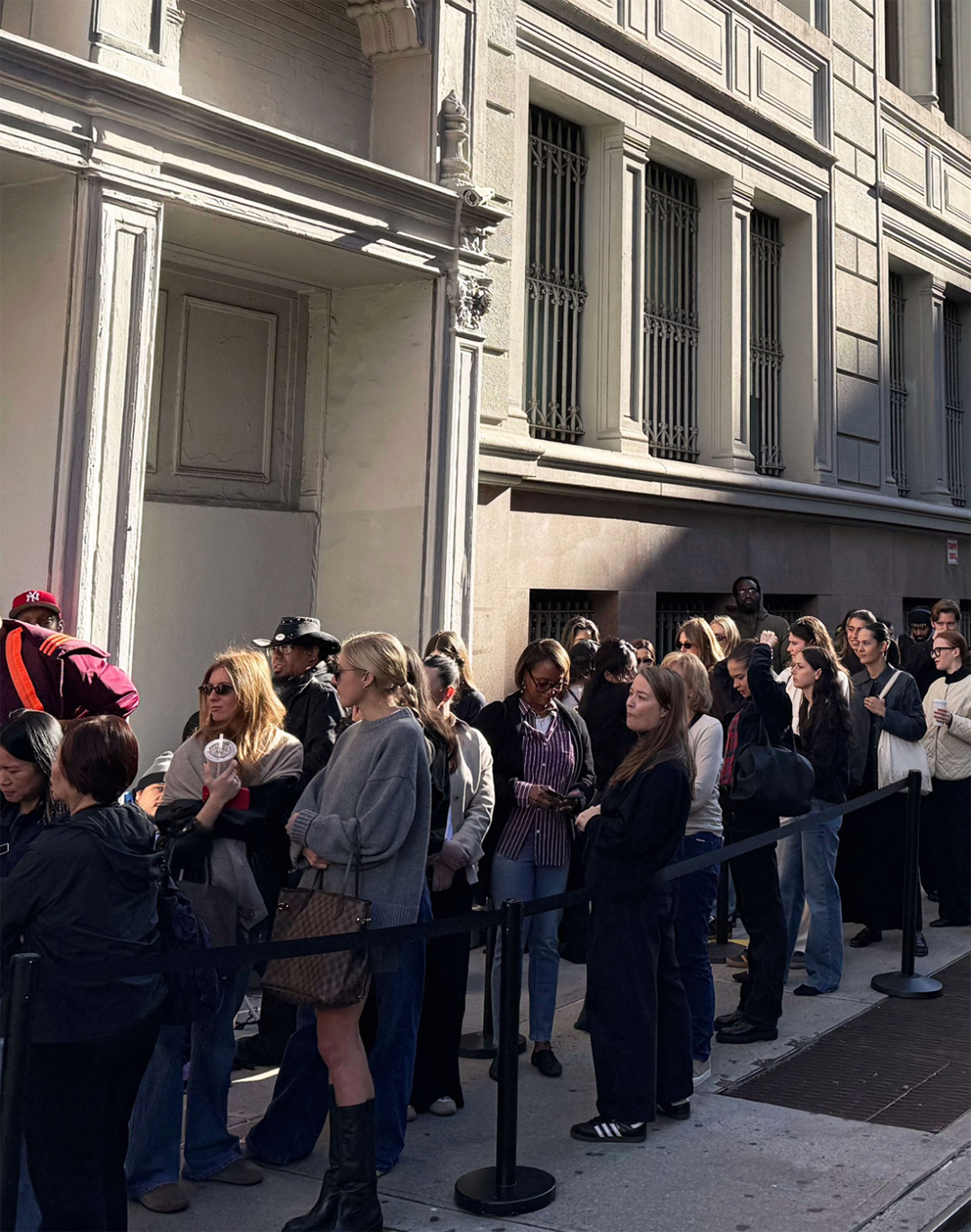
A familiar scene in New York fashion culture: shoppers queue for hours outside a luxury sample sale, where patience is often the first price of admission.
Viewed from this perspective, the sample sale begins to resemble a form of cultural theatre. Participants are not simply purchasing products; they are participating in a ritual built around scarcity, anticipation, and the possibility of discovery. The atmosphere combines elements of treasure hunting, competition, and social signaling in a way that traditional retail rarely achieves.
Luxury brands themselves maintain an understandably complicated relationship with this world. Contemporary labels such as THEORY, HELMUT LANG, MICHAEL KORS, DIANE VON FÜRSTENBERG, CHLOÉ, JIMMY CHOO, and MARC JACOBS regularly appear through private sales, specialist organizers, and retailer events. For these brands, sample sales have become an accepted mechanism for managing inventory while maintaining consumer interest.
The most powerful luxury houses remain considerably more cautious. A direct CHANEL, HERMÈS, or LOUIS VUITTON sample sale is exceptionally rare. These brands have spent decades constructing narratives around permanence, exclusivity, and desirability, and public markdowns sit uneasily within that framework. Their preference is to preserve the illusion that demand always exceeds supply.
Even so, luxury is not entirely immune to commercial realities. Inventory eventually finds its way through private client events, discreet clearances, department store channels, and secondary markets. The route may be less visible, but the underlying principle remains the same.
Perhaps the most interesting lesson of the sample sale is what it reveals about consumer psychology. Many shoppers arrive intending to purchase a specific item and leave with far more than they anticipated. A handbag reduced from $1,300 to $130 or a sweater marked down from $300 to $30 can alter perceptions of value almost instantly. The discount becomes part of the product’s appeal, sometimes eclipsing the product itself.
Luxury marketing traditionally suggests that desire creates value. Sample sales suggest that the relationship can work in reverse. A sufficiently dramatic discount can generate desire where none previously existed. The object becomes attractive not only because of what it is, but because of what it once cost.
This is why the sample sale continues to thrive despite its apparent contradictions. It offers luxury consumers something increasingly rare: the feeling of discovering value in a market designed to eliminate surprises. Whether shoppers leave with a carefully considered purchase or several items they never intended to buy, they leave with a story. And in luxury, stories often prove just as valuable as the products themselves.
At CRIS & COCO, that may be the most interesting part of all.