
The Dupe Was Inevitable
Luxury created the conditions for its own imitation. Now it would rather blame the customer.
For years, the luxury industry has been fighting a heroic battle against dupes. Lawyers send letters. Brands demand stronger enforcement. Fashion executives lament the erosion of craftsmanship, intellectual property and creativity. China is blamed. TikTok is blamed. Fast fashion is blamed. Consumers, apparently suffering from a mysterious collapse in moral judgment, are blamed too.
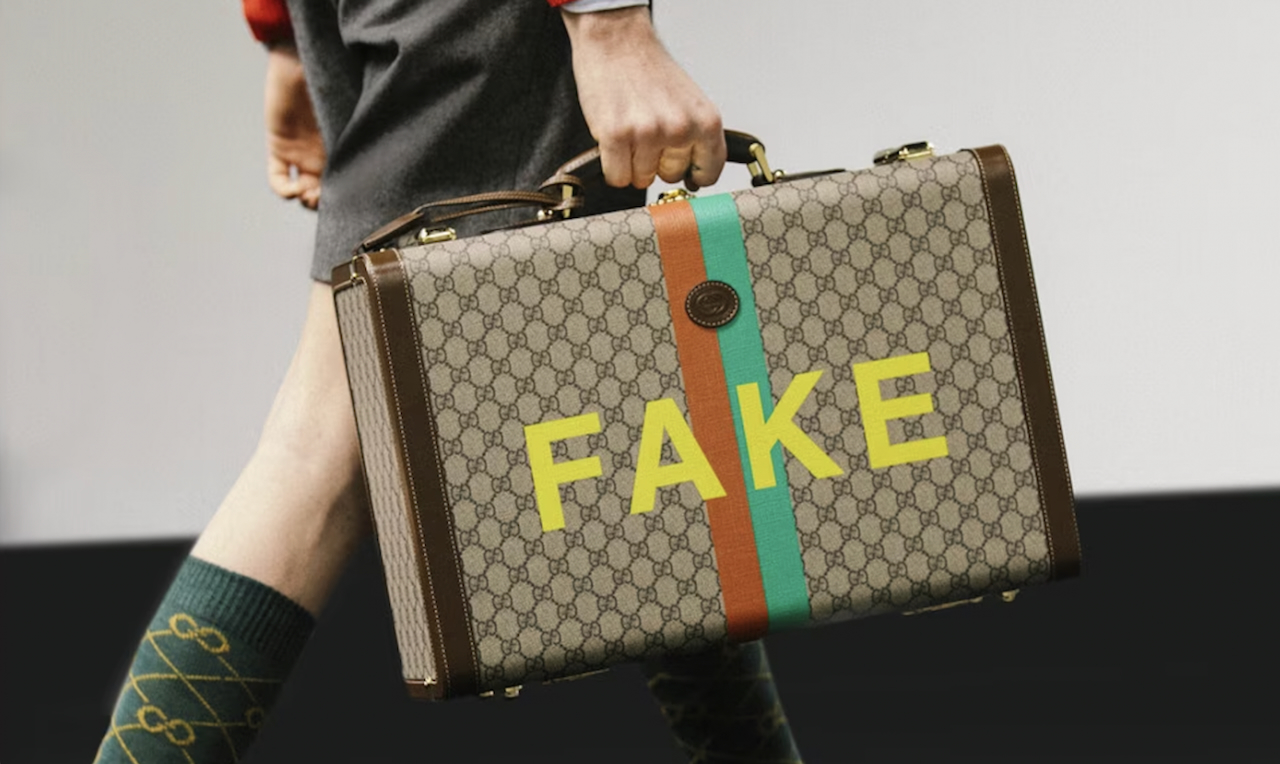
GUCCI decided that if you can’t make the fakes disappear, you might as well put FAKE on the real thing. A rather elegant way for a luxury brand to face its counterfeit problem: with humor instead of indignation.
Almost everyone gets a turn. Except, curiously, the luxury industry itself. Perhaps it is time to consider a less comfortable possibility: the dupe is not an attack on the modern luxury business. It is one of its products.
Luxury spent decades increasing prices, expanding production, standardizing design, industrializing desire and teaching consumers to recognize a product from twenty meters away. Then it seemed surprised when somebody figured out how to make something that looked remarkably similar for $79.
The dupe wasn't an accident. It was inevitable.
First, Make Desire Unaffordable
There is nothing particularly strange about a rare object being expensive. A hand-built automobile is expensive. A unique piece of jewelry can be expensive. A couture dress requiring hundreds of hours of skilled labor should be expensive.
The interesting question begins when an industrially produced fashion accessory costs several thousand dollars.
Of course, material value has never been the point of luxury. We understand this. A handbag is not priced by adding leather, thread, zipper and labor and then applying a modest retail margin. Luxury sells design, heritage, craftsmanship, scarcity, status, fantasy, cultural participation and, occasionally, a rather beautiful box.
Fair enough.
But over the past two decades, something changed. Prices began rising much faster than the underlying objects seemed to improve.
The explanation is often inflation, materials, craftsmanship, rents, wages and currency fluctuations. All real things. But another force has been prowling around the luxury garden: financialization.
Luxury houses increasingly belong to enormous publicly traded groups, investment structures and private-equity portfolios. They are not merely expected to make beautiful things. They are expected to grow.
Every year.
Preferably faster than last year.
The Germans have a wonderfully agricultural nickname for aggressive private-equity investors: Heuschrecken. Locusts. It is unfair to apply the term indiscriminately, but the image is irresistible: arrive, extract value, improve margins, demand growth, move on.
The romantic maison and the spreadsheet have become roommates.
The $20,000 Wardrobe Problem
Here is where the industry's argument becomes slightly absurd.
Fashion tells women that clothes are self-expression. Develop your style. Experiment. Change. Mix references. Try another silhouette. Wear color. Wear black. Discover a new designer. Reinvent yourself. Don't repeat the same look forever.
Wonderful advice.
Then luxury presents the bill.
A CHANEL bag can cost $10,000. PRADA Shoes can cost $1,700. A SAINT LAURENT jacket can cost $8,500. Add sunglasses, jewelry, watches, knitwear, something for summer, something for winter, something understated, something ridiculous, and perhaps a tiny evening bag incapable of carrying an evening.
Apparently, authenticity requires quite a budget.
And one item is not enough, because fashion's entire cultural proposition depends upon change.
A genuinely varied luxury wardrobe containing different designers, colors, moods, seasons, and narratives can easily cost as much as a new car.
And then fashion changes again.
This creates a peculiar form of consumer arrogance in reverse. The industry essentially says: We have decided that this fashionable object is worth several thousand dollars. If you appreciate the design but cannot or will not pay that amount, you should simply abstain.
Consumers looked at that proposition and invented another answer.
No.
China Didn't Invent the Incentive
China makes an easy villain because China became extraordinarily good at manufacturing things. But blaming China for dupes is a little like blaming photocopiers for paperwork.
Factories manufacture what markets demand.
For decades, Western brands deliberately built enormous supply chains across Asia because those supply chains could produce sophisticated products quickly, reliably, and cheaply. Manufacturing knowledge spread. Machinery improved. Materials became accessible. Product development accelerated. Global logistics became astonishingly efficient.
Meanwhile, Instagram, TikTok, influencers and luxury brands themselves distributed high-resolution images of desirable products across the planet within seconds.
Luxury effectively created the world's most efficient desire-distribution system and connected it to the world's most efficient manufacturing system.
What exactly did everyone expect to happen?
When the Story Costs More Than the Thing
The luxury industry is correct about one important point: a genuine product and a dupe are not the same thing. But that is precisely why the dupe is interesting. It acts as a crude little laboratory experiment.
Take away the boutique. Take away the heritage. Take away the celebrity campaign, the fashion show, the packaging, the logo mythology, the scarcity narrative and the carefully cultivated social meaning.
What remains?
Sometimes quite a lot. Sometimes alarmingly little.
Dupes aren't stealing luxury's value so much as measuring how much of that value existed in the narrative in the first place. That doesn't make copying admirable. It makes copying revealing.
Luxury Standardized Itself
There is another problem, and perhaps a more dangerous one. Luxury became easier to imitate because luxury itself became more standardized.
The industry consolidated. Conglomerates grew. Consultants circulated. Executives moved between houses. The same celebrities appeared in campaigns. The same global cities received the same gleaming stores. The same airports became luxury shopping malls with attached departure gates.
Design still matters enormously, and extraordinary creative work still emerges. But the commercial machinery surrounding it has become remarkably uniform.
When every brand needs recognizable icons, quarterly growth, global scalability, social-media visibility, and products capable of becoming bestsellers across continents, differentiation begins fighting economics.
The paradox is delicious.
Luxury needs to be distinctive enough to desire and standardized enough to scale.
The dupe merely finishes the equation.
The Difference Between a Dupe and a Fake
There is also a distinction worth defending.
A counterfeit pretends to be something it isn't. It uses another company's trademark and sells deception.
A dupe usually does something more slippery. It says, essentially: You know that shape everybody wants? Here is our version.
Fashion has always worked this way to some degree. Ideas migrate from couture to ready-to-wear, from runway to department store, from subculture to luxury, from luxury back to the street. Designers quote history, vintage clothing, uniforms, workwear, indigenous textiles, punk, sportswear, and one another.
The industry prefers to call this inspiration when it travels upward.
When it travels downward, the vocabulary becomes less charitable.
Consumers Aren't Stupid
This may be the largest mistake luxury can make.
Consumers understand the game better than the industry sometimes assumes.
They know a $4,000 handbag does not contain $4,000 worth of leather. They know the campaign starring a famous actress cost money. They know the boutique on Avenue Montaigne costs money. They know they are buying participation in a cultural narrative.
Many are perfectly happy to do so.
The problem begins when the gap between price and perceived value becomes too large.
At that point, the consumer doesn't necessarily stop wanting the design.
She stops accepting the equation.
The dupe appears in that gap.
Perhaps Luxury Should Become Luxurious Again
The solution to dupes probably isn't to lecture consumers more vigorously.
It may be to make the original harder to substitute.
True scarcity is difficult to dupe. Exceptional craftsmanship is difficult to dupe. Extraordinary materials are difficult to dupe. Personal service is difficult to dupe. Provenance is difficult to dupe. A genuinely original idea remains difficult to dupe, at least until Tuesday.
Luxury has enormous territory available beyond logos and pricing power.
Make things worth repairing. Make things people keep for twenty years. Make strange things. Make difficult things. Make products whose value becomes more apparent when you hold them rather than less.
Perhaps even make fewer of them.
That would require accepting something modern capitalism finds surprisingly uncomfortable: not everything has to scale indefinitely.
The Copy Has a Message for the Original
The dupe is usually treated as an inferior object standing outside the gates of luxury, trying to sneak in.
Perhaps we have the relationship backward. It is feedback.
It tells the industry where consumers still perceive design value but no longer perceive corresponding monetary value. It reveals which products are genuinely distinctive and which depend primarily on recognition. It exposes the widening distance between what something costs to make, what it costs to buy and what people believe it is worth.
For years, luxury has asked consumers to buy authenticity.
Consumers have started asking luxury to prove it.
And that may be the most authentic thing to happen to the industry in years.