
The Frivolancer Economy
When Fashion Ran Out of Attention
There was a time when becoming a fashion influencer looked suspiciously like escaping work.
You dressed well, went somewhere photogenic, photographed yourself holding something expensive and gradually converted the performance of having a desirable life into an occupation. The product was ostensibly fashion, but the real product was aspiration. The handbag, hotel, sunglasses and impossible breakfast were props in a larger transaction: I have access to this life; perhaps you could too.
It was an extraordinarily successful business model. So successful, inevitably, that everybody copied it.
Fashion influencers now compete not only with one another but with brands, celebrities, retailers, publications, resale platforms, paid UGC, professional clipping operations and an expanding ocean of synthetic content. The problem is not that attention has disappeared. The supply of things demanding it has exploded, while the number of hours in a human day has stubbornly refused to increase. A soiled-looking Prada cotton shirt, yours for $2,850. Rage bait, trolling, greedflation, bad taste, attention seeking, or simply price itself as luxury strategy?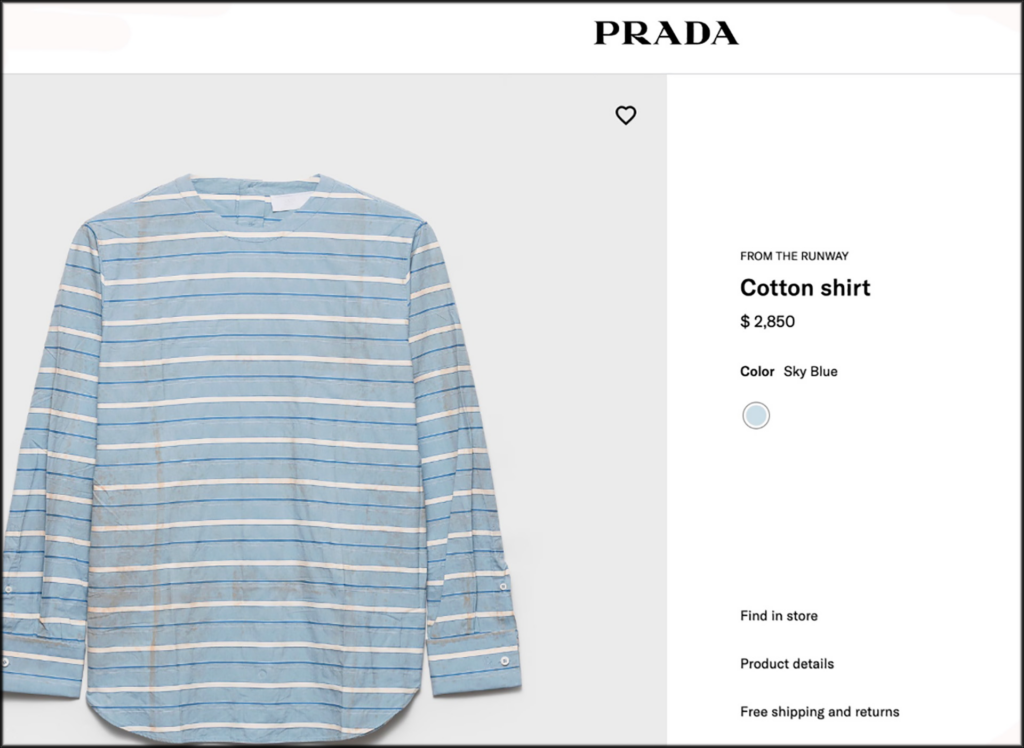
The influencer economy has discovered the same uncomfortable law that fashion itself knows very well: abundance destroys distinction.
And so the frivolancer has had to evolve.
The Frivolancer Grows Up
We coined frivolancer some time ago for a particular creature of contemporary fashion culture: someone whose apparent occupation consists largely of being photographed attending, wearing, unboxing, holidaying and lunching.
But the word has become more interesting because the frivolancer's job is becoming considerably less frivolous.
Rebecca Jennings’s recent New York Magazine article, “You Can’t Just Be Showing Matcha-Pilates-Alo,” follows Audrey Peters, a 29-year-old New York lifestyle influencer who built her audience around luxury fashion, from CHANEL shopping trips to HERMÈS appointments, and has since become an unusually candid practitioner of strategic rage bait. Through Peters, Jennings describes an influencer economy undergoing something resembling a labor-market correction.
Peters herself is a fascinating case because she understands this perfectly. Luxury fashion remains her territory, but the familiar material has stopped performing as it once did. A trip to CHANEL that could once attract millions of views might now attract a fraction of that. Even she admits to being bored with watching yet another influencer unbox a Birkin.
This isn't necessarily the death of luxury. It may be the death of luxury as reliable content.
There are simply too many Birkins on the internet.
That creates a peculiar predicament. The frivolancer was hired to make us want things. Now she increasingly has to make us feel something about them.
Admiration will do.
Desire is better.
But anger works surprisingly well.
From Aspirational to Irrational
Rage bait sounds like the opposite of luxury marketing.
Luxury spent decades controlling every pixel of its image. The lighting was exquisite. The model was exquisite. The shop was exquisite. The advertising existed in a hermetically sealed universe in which nobody had mortgages, grocery bills or irritating neighbors.
Social media punctured the membrane.
Fashion discovered that a ridiculous object can travel farther than a beautiful one. An absurd price can generate more attention than an elegant campaign. Something doesn't necessarily need to be desirable anymore. It needs to be discussable.
This produces a fascinating new category of fashion object: the product that functions simultaneously as merchandise and media.
A roughly $3,000 Prada shirt that appears dirty, discussed in the video that prompted this article, doesn't have to persuade millions of people to buy it. Almost none of them will. It only needs to make millions of people ask the obvious question:
Who the hell would pay $3,000 for that?
The price has become part of the content.
And here the frivolancer economy collides with something we've been watching for much longer: the financialization of fashion.
The Price Is the Message
Luxury prices used to communicate fairly legible things. Better materials. Craftsmanship. Provenance. Exclusivity. Status. Sometimes simply an expensive brand name sewn into a relatively ordinary object.
Those explanations have become increasingly inadequate.
The modern luxury price can perform several jobs simultaneously.
A higher price protects scarcity. It separates luxury from an increasingly sophisticated mass market capable of producing aesthetically convincing alternatives. It raises margins. It strengthens the perception of investment value. It reassures existing owners that their purchases belong to an appreciating universe rather than a depreciating wardrobe.
But now price can do something else.
It can generate attention.
The outrageous price becomes a marketing asset in its own right.
A $300 shirt may pass unnoticed. A $3,000 shirt that looks as though someone repaired a motorcycle in it becomes a story. People screenshot it. Creators discuss it. Comment sections ignite. Publications write about it. People who would never voluntarily watch a Prada campaign suddenly participate in Prada's cultural circulation.
Whether the brand deliberately engineered the object as rage bait almost becomes irrelevant. The attention economy has learned how to use it as rage bait anyway.
That changes the economics of outrageous fashion.
The question is no longer merely whether enough customers will buy the product to justify its existence. Its absurdity can create a secondary return through attention.
The price itself has become media.
Luxury's Inflationary Spiral
This gives the extraordinary inflation of luxury prices another possible meaning.
We've previously looked at fashion's transformation from an industry selling beautiful things into one increasingly governed by the logic of assets: scarcity, controlled distribution, resale values, investment narratives and relentless price escalation.
But financialization and the attention economy may now be reinforcing each other.
Raise the price and the product becomes more exclusive.
Raise it further and it becomes scarce.
Raise it further still and it becomes news.
At some point, economic irrationality acquires marketing value.
That doesn't mean every luxury price increase is a cynical attempt at rage bait. That would be far too neat. The more interesting point is that several systems which once operated separately are beginning to overlap.
Scarcity creates desire. Financialization encourages price escalation. Price escalation creates outrage. Outrage creates engagement. Engagement creates visibility. Visibility reinforces cultural importance. Cultural importance helps justify the price.
The snake has discovered a remarkably profitable way of eating its own tail.
And influencers sit conveniently in the middle of the loop.
When the Birkin Stops Working
This may explain something that initially looks contradictory.
Luxury goods remain extraordinarily potent status objects, yet luxury content can feel exhausted.
The distinction matters.
A Birkin can remain desirable precisely because relatively few people can obtain one while simultaneously becoming boring online because we've seen thousands of them. Physical scarcity can coexist with digital abundance.
That is a strange new problem for luxury.
The object is scarce.
The image of the object is infinite.
For years, influencers solved this by giving audiences access to otherwise inaccessible worlds. Come shopping with me at Chanel. Come to Paris Fashion Week. Come to the hotel. Come to the fitting. Come watch me open the box.
But eventually we came.
Again and again and again.
Jennings describes precisely this erosion of aspirational luxury content. Peters says the shopping videos that once generated millions of views have weakened considerably, while audiences have become less receptive to endless displays of free PR, designer purchases and privileged lifestyles.
The industry's response is telling. If aspiration no longer guarantees attention, provocation might.
The frivolancer therefore begins mutating from professional aspirational person into professional reaction generator.
The Rage Bait Trap
There is, however, an obvious problem with an economy built on provocation.
It suffers from exactly the same mechanism that destroyed the previous one.
Everybody learns the trick.
Once creators discover that outrage performs, feeds fill with outrage. Once brands discover that strange products attract attention, strange products multiply. Once deliberately ugly fashion becomes culturally legible, ugliness itself becomes conventional.
The shocking thing develops the same problem as the beautiful thing.
There is too much of it.
Rage bait therefore contains its own obsolescence. Every escalation raises the threshold required for the next reaction. Yesterday's ridiculous handbag becomes today's mildly eccentric handbag. Yesterday's outrageous price becomes today's luxury baseline.
The attention arms race has nowhere comfortable to end.
And fashion, perhaps more than any other industry, should recognize the danger. Fashion depends on novelty, but novelty is difficult to manufacture when everyone is manufacturing novelty simultaneously.
The Algorithm Is the New Editor
The old fashion system had gatekeepers. Editors decided what appeared in magazines. Buyers decided what appeared in stores. Designers and creative directors attempted to establish what came next.
The algorithm has no taste.
It has feedback.
That distinction may be one of the most consequential changes in contemporary fashion culture.
A magazine editor could decide that something deserved attention. An algorithm largely observes that something is receiving attention and gives it more.
The difference rewards reaction.
Beautiful can work. Intelligent can work. Original can work. But anger, disbelief and correction have a structural advantage because they compel participation.
The frivolancer understands this because her livelihood depends upon understanding it.
Jennings's article is striking in how little romance remains around the profession. Brands scrutinize engagement rates. Influencers monitor link clicks. Campaigns are judged against conversions. Peters describes deliberately using curiosity and price to generate clicks. What appears from the outside to be someone casually sharing her life increasingly resembles a tiny performance-marketing company with a human face.
The frivolancer has KPIs now.
How terribly corporate.
Fashion After Influence
And then comes the most amusing turn of all.
After years spent turning bloggers into influencers, the influencer economy is rediscovering writing.
Jennings describes renewed interest in newsletters and Substack because smaller audiences who intentionally subscribe can be more engaged and commercially useful than enormous populations of people who happen to encounter someone in a feed. The fashion industry is beginning to value not merely reach but attention with intent.
In other words, after optimizing photographs, videos, Stories, Reels, TikToks, unboxings, hauls and rage bait to survive ever-shorter attention spans, the industry has stumbled upon a revolutionary new technology:
People who actually want to hear from you.
Perhaps that is where the influencer recession becomes genuinely interesting.
The influencer isn't disappearing. Influence is being repriced.
A million followers who barely notice you may be worth less than a much smaller group who deliberately seek you out. Visibility isn't the same as relevance. Engagement isn't necessarily affection. And outrage, despite producing wonderful graphs, isn't loyalty.
Fashion may be rediscovering the difference between an audience and a crowd.
The Frivolancer Recession
So perhaps the frivolancer isn't dying either.
She is being forced to acquire a point of view.
That may prove uncomfortable for an industry that spent years demonstrating that personality could itself be industrialized. Find the right apartment. The right Pilates class. The right restaurant. The right bag. The right holiday. The right filter. Repeat until monetized.
But formulas are vulnerable to success.
Once everybody knows how to manufacture aspiration, aspiration becomes generic. Once everybody understands rage bait, outrage becomes wallpaper. Once everybody becomes an influencer, influence itself becomes scarce.
Which returns fashion to a surprisingly old-fashioned proposition.
Make something worth looking at.
Say something worth reading.
Have an idea that cannot be reproduced merely by copying the format.
The frivolancer economy was built on the fantasy that attention could be converted endlessly into money. Its recession reveals the flaw in the model. Attention isn't infinite, and the amount of content fighting for it increasingly is.
Luxury fashion has responded with scarcity, financialization, escalating prices and, whether deliberately or accidentally, products capable of functioning as rage bait. Influencers have responded by becoming ever more strategic about provoking, measuring and converting attention.
Both may eventually encounter the same problem.
When everything is engineered to get our attention, not giving it may become the ultimate luxury.