
FASHION FOMO WAS INVENTED BEFORE INSTAGRAM
Georg Simmel explained fashion’s psychological trap in 1904. The industry has spent the next 122 years making it faster.
Years ago, my former partner, Andrea, a stylist, had a surprisingly effective method for surviving PRADA.
She would look at a new collection, find something she desperately wanted and, when buying it was out of the question, console herself with a simple thought: There will be another great piece next season.
There always was.
At the time, this seemed like a practical way of negotiating an expensive enthusiasm. Looking back, it was practically applied sociology. Andrea had accidentally discovered the antidote to fashion FOMO: remembering that fashion is contractually obliged to make you fall in love again.
Georg Simmel could have told her that in 1904.
In his essay Fashion, the German sociologist described a system driven by two opposing human desires. We want to belong, and we want to distinguish ourselves. We imitate the people whose world we want to inhabit, then become uncomfortable when too many people start looking like us.
Fashion lives inside that contradiction. Luxury merely discovered how profitable it could be.
THE MACHINE HAS ONLY TWO BUTTONS
Simmel understood fashion as something much more interesting than clothing. It was a social mechanism, a way of negotiating our position among other people.
Imitation gives us reassurance. Dressing like a group tells us that we belong to it, or at least understand its codes. A suit, a sneaker, a handbag, a haircut can quietly announce tribe, class, profession, generation, taste and aspiration before anyone has said hello.
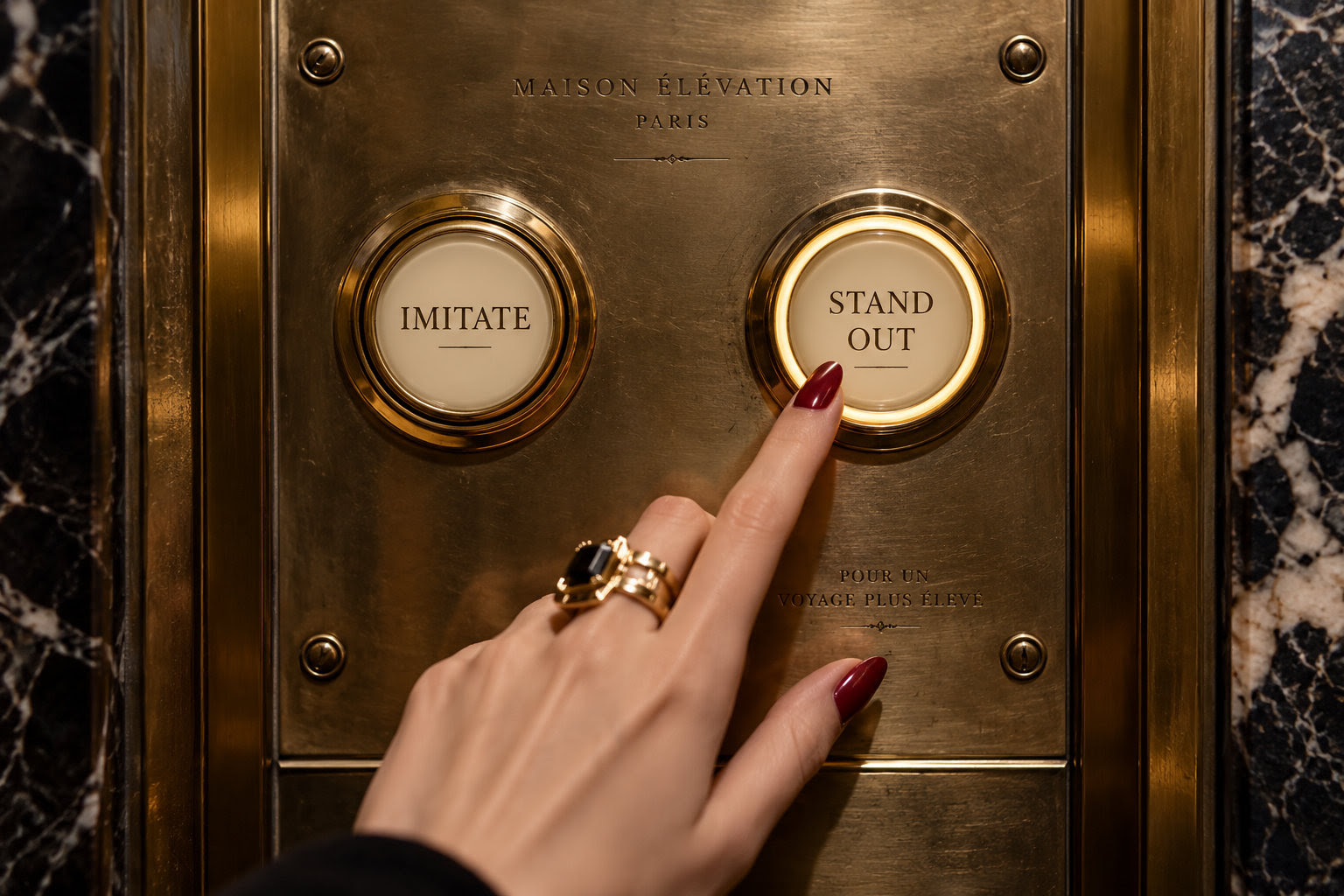
Fashion’s eternal dilemma: fit in, stand out. Please select both.
But complete conformity creates another problem. Nobody wants to disappear entirely into the wallpaper.
So we differentiate. We choose the unusual version, the difficult color, the obscure designer, the vintage piece nobody else found. We want recognition without surrendering individuality.
This is fashion’s magnificent little psychological machine: Please notice that I belong. Please notice that I am different.
Luxury has been pressing both buttons ever since.
THE PROBLEM WITH GETTING WHAT YOU WANT
Simmel’s more uncomfortable observation was that fashion contains its own mechanism of destruction.
A style acquires desirability partly because certain people have it and others do not. Then other people imitate them. The style spreads. Its success increases precisely until that success begins destroying the distinction that made it desirable.
The original group moves elsewhere.
This is sometimes reduced to “trickle-down,” but that makes the phenomenon sound almost economic. Simmel was describing something more psychological: symbolic distance. The object matters because of what it separates you from and what it connects you to.
That helps explain one of luxury’s strangest commercial problems. A handbag can become so successful that its ubiquity begins working against it. A logo can become so recognizable that recognition itself becomes vulgar. The product has achieved every conventional marketing objective and somehow damaged the thing it was marketing.
Congratulations. Everybody wants it.
Emergency meeting.
FOMO ISN’T A BUG. IT’S THE ENGINE.
This is where Andrea and her imaginary future PRADA come in handy.
Fashion FOMO persuades us that the present object is uniquely urgent. This jacket. This bag. This collaboration. This color. This season. Miss it and some tiny cultural door may close forever.
Except fashion cannot afford forever.
The entire system depends on replacing today’s urgency with tomorrow’s urgency. The miraculous object currently occupying your thoughts must eventually surrender the stage to another miraculous object, otherwise the next collection has a serious problem.
Social media did not invent this anxiety. It industrialized its delivery.
Simmel’s fashion world moved through social observation, cities, classes and social circles. Ours arrives through a glowing rectangle before breakfast. Celebrities introduce signals, influencers amplify them, algorithms measure our response, resale markets assign them fluctuating monetary values, fast fashion translates them, and within days we can watch an aesthetic move from discovery to saturation while sitting perfectly still.
The hype cycle feels faster because it is faster. But its engine is antique.
And that gives FOMO a rather wonderful weakness: the next thing is already coming.
The object telling you now or never belongs to an industry built almost entirely on again and again.
WHEN EVERYBODY BECAME THE ELITE
There is one important place where Simmel’s world no longer quite describes ours.
Fashion no longer moves neatly downward.
A teenager on TikTok can influence a luxury house. Streetwear enters couture. Vintage collectors resurrect forgotten bags. Designers excavate their own archives. Counterfeiters respond to runway collections with astonishing speed. A niche aesthetic can emerge online, be absorbed by a multinational brand, reproduced by mass retailers and declared exhausted before half the population has learned its name.
The pyramid has become a pinball machine.
Luxury now copies culture while culture copies luxury, which then copies its own archive because everybody has been copying that too. AI enters the scene trained on the accumulated visual evidence and cheerfully offers another few million variations.
Simmel’s fundamental tension survives because the hierarchy was never really the point. We still want the same contradictory things: membership and distinction.
Only now everybody can see everybody else trying to achieve them.
No wonder we’re tired.
EVEN QUIET LUXURY GOT TOO LOUD
Few recent trends demonstrate the Simmel machine as beautifully as quiet luxury.
Logos had become ubiquitous. Loud recognition no longer communicated sufficient distinction, so status performed its favorite disappearing act. The signal became subtle materials, restrained colors, impeccable cuts and objects recognizable primarily to people who were supposed to recognize them.
Luxury hadn’t abandoned signaling. It had developed a dog whistle.
Then everybody started talking about quiet luxury.
Suddenly there were explainers on how to achieve it, affordable versions of it, influencers demonstrating it and retailers merchandising it. “Stealth wealth” became one of the least stealthy ideas in fashion.
The uniform designed to distinguish its wearer from people wearing uniforms became a uniform.
Simmel wins again.
This is why the fashion cycle cannot be permanently solved by discovering the correct aesthetic. Minimalism eventually becomes conventional. Maximalism eventually becomes conventional. Logos become embarrassing until they become ironic, then archival, then cool, then ubiquitous, then embarrassing again.
Fashion does not march toward an aesthetic conclusion.
It circles.
THE LUXURY OF NOT PANICKING
Perhaps Simmel’s most useful contribution in 2026 isn’t explaining fashion. It is making fashion less frightening.
Once you see the mechanism, urgency becomes slightly comic.
That doesn’t mean abandoning fashion, desire or beautiful things. Quite the opposite. Fashion becomes more enjoyable when every new object no longer has to function as an admission ticket to the present.
You can love the PRADA and not buy the PRADA.
There will be another PRADA.
And perhaps that creates room for a different relationship with luxury. Not an impossible fantasy in which humans suddenly stop imitating each other, wanting status or enjoying novelty. Simmel would probably laugh us out of the room. But we can become more interested in objects that survive the cycle: things repaired, collected, inherited, rediscovered, worn strangely, combined incorrectly and kept long enough to accumulate a biography.
The most interesting luxury might eventually be something fashion has difficulty manufacturing on schedule: attachment.
An object you still love after the algorithm has stopped showing it to you has passed a rather more demanding test than exclusivity.
Simmel diagnosed the fashion machine 122 years ago. Since then we have added global luxury conglomerates, influencers, drops, resale platforms, dupes, TikTok, algorithms and artificial intelligence. We have accelerated nearly every component.
But the machine still has the same two buttons.
Belong.
Be different.
And whenever fashion FOMO starts whispering that this particular object, this particular collection, this particular moment cannot possibly be missed, Andrea’s little philosophy remains remarkably effective.
Relax.
There will be another great piece next season.