
I Thought the Future Would Be Cooler
Why Nothing Feels Cool Anymore
There is a song by the American band Yacht called I Thought the Future Would Be Cooler. It was released more than a decade ago, long before artificial intelligence, TikTok, algorithmic shopping, and large language models quietly rearranged the cultural furniture of everyday life. At the time, it read like a clever piece of indie irony. Today, it feels uncomfortably literal.
Not because the future failed to arrive.
But because it arrived looking suspiciously like everything else.
We were promised rupture. Flying cars, immersive virtual worlds, creative liberation at planetary scale. A technological age that would multiply individuality rather than smooth it out. Instead, we got a world that feels eerily consistent from city to city: the same café aesthetic, the same apartment staging, the same hotel lobby lighting, the same fonts, the same curated imperfection that somehow always feels professionally approved.
The future did not disappoint us.
It standardized us.
Somewhere along the way, it stopped surprising us and became exceptionally good at repetition.
The Great Flattening
Walk through almost any fashionable district in the world and a strange déjà vu sets in. The café has the same poured concrete counter. The boutique sells the same oversized linen shirt. The hotel lobby smells like a memory you never actually had but somehow recognize. The branding is always restrained, the palette always earthy, the ceramics always artisanal, the soundtrack always drifting between ambient electronica and carefully nonchalant indie.
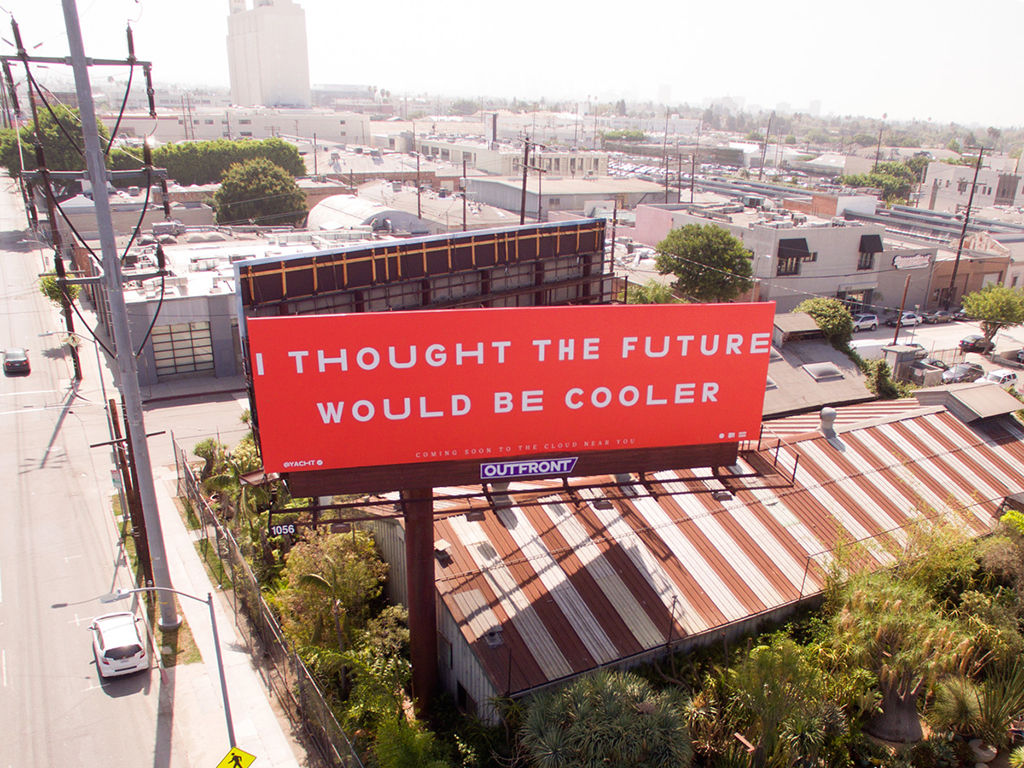
A witty urban billboard reads “I thought the future would be cooler,” capturing the gap between our futuristic expectations and everyday modern reality.
You have seen this place before.
Not because you travel too much.
But because everywhere has started to resemble everywhere else.
Cool used to be geographically anchored. It had an accent, a context, a sense of origin. You went to Tokyo for Tokyo, to Milan for Milan, to Copenhagen for Copenhagen. Difference was the point.
Now difference is just a variation in export settings.
The internet promised infinite cultural diversity. What it delivered instead was convergence at scale. Algorithms do not reward originality; they reward recognizability with minor deviation. They prefer the familiar slightly reassembled, the known gently rebranded.
So a design language born in Copenhagen becomes a hotel in Dubai, which becomes a café in Bangkok, which loops back into Stockholm as “Japanese-inspired minimalism with Mediterranean warmth.” Every reference is real. The combination is not.
Everyone is borrowing from everyone else until nobody remembers who started the conversation.
Global culture has become one enormous Pinterest board.
This is wonderful. It is also exhausting.
Global culture has become a single, endlessly replicated mood board that no one remembers assembling.
The Slop Economy
Every technological revolution begins with democratization. Photography, publishing, video, music production, design tools, distribution platforms—each wave lowers the barrier to entry and expands the number of people who can participate in cultural production.
This is, in almost every sense, a triumph.
It is also where things become interestingly overwhelming.
When creation becomes frictionless, output becomes infinite. And when output becomes infinite, quality stops being the differentiator. Competence becomes the baseline. Everything is well lit, well designed, well edited, and, increasingly, indistinguishable.
The internet is now saturated with what can only be described as competent excess: work that is technically correct, aesthetically fluent, and emotionally forgettable.
Not because people have become less talented. There may be more talent than ever. But much of it draws from the same references, responds to the same incentives, and ultimately converges on the same ideas.
This is the Slop Economy—not as an insult, but as a structural condition. A world where supply has expanded faster than attention, and where the median quality of everything has quietly converged toward “good enough to scroll past.”
When everything is possible, nothing feels necessary.
The Copy Machine Became Instant
Originality used to enjoy a brief, almost romantic delay. A new idea would appear, circulate slowly, mutate locally, and only then be absorbed into the mainstream.
That delay is gone.
Today, success is immediately legible and instantly reproducible. A handbag goes viral and is reverse-engineered within days. A visual identity gains traction and is replicated across continents before the original brand has finished its next campaign cycle. A TikTok aesthetic emerges and is industrialized before it has even stabilized into something coherent.
Even cultural discovery has become a form of real-time extraction.
Platforms do not just distribute ideas; they disassemble them. Meta’s ad libraries, TikTok analytics, and e-commerce dashboards turn creativity into a transparent system of inputs and outputs. What once required intuition can now be reverse-engineered.
The result is a strange acceleration: the lifecycle of originality has collapsed. It no longer has time to mature before it is cloned, optimized, and reissued as variation.
Success has become a template.
And templates, by definition, are meant to be copied.
AI Doesn’t Invent Culture
Artificial intelligence complicates this further, not because it is radically creative, but because it is structurally conservative.
It predicts. It averages. It interpolates. It produces the most statistically probable version of whatever you ask for.
Which makes it extraordinarily powerful—and culturally cautious.
AI is not a generator of rupture. It is a generator of consensus. It compresses the past into a smooth, optimized present. It is, in many ways, the perfect machine for a world already addicted to familiarity.
But culture does not evolve through consensus.
It evolves through deviation.
David Bowie was not an average of his time. Martin Margiela was not an optimization of existing fashion logic. Comme des Garçons did not emerge from customer research. The first iPhone was not the most likely phone—it was, in many ways, the least predictable one.
The uncomfortable truth is that cultural breakthroughs often look wrong before they look inevitable.
Prediction systems struggle with this because they are trained on what already exists. Culture, at its most interesting, is what refuses to exist until it does.
Consumers Graduated
There is another shift happening quietly in parallel: the audience has become far more literate than most brands are prepared to acknowledge.
Luxury used to operate on opacity. It relied on distance, mystique, and controlled information. Today, that distance has collapsed. Consumers know production costs. They understand supply chains. They watch factory breakdowns on YouTube. They compare materials, margins, and marketing strategies with the fluency of analysts.
Entire subcultures now exist to decode the mechanics of branding itself.
The customer, in effect, has completed a crash course in how everything is made.
And once you understand how the illusion works, it becomes harder to be impressed by it.
Luxury Was Never About Leather
One of the most persistent misunderstandings in luxury is the belief that value begins with material quality. It does not. Materials matter, of course, but they are only the most visible layer of a much deeper structure.
Luxury is accumulated meaning.
It is architecture, photography, typography, service, language, scarcity, timing, cultural memory, and above all, consistency. It is the slow construction of a world that feels internally coherent enough to justify belief.
The object is never the point.
It is the entry ticket.
People do not buy luxury products because they need them. They buy them because they want access to a narrative that feels more intentional than the everyday world around them.
The World Is the Product
This is where many contemporary brands misread the moment. They continue to think in terms of products when the real competition is between worlds.
Apple does not sell devices. It sells a controlled environment of interaction. Patagonia does not sell jackets. It sells a moral and ecological worldview. HERMÈS does not sell bags. It sells continuity across generations. LEGO does not sell plastic bricks. It sells structured imagination.
In each case, the object is secondary. The system around it is primary.
The strongest brands are not catalogues. They are places you can mentally inhabit.
The Return of Taste
For a long time, we outsourced taste to systems that promised efficiency. Streaming platforms decided what we listened to. Feeds decided what we saw. Recommendation engines decided what we discovered. Gradually, curation became invisible, and invisibility made it feel neutral.
But something is shifting again.
As algorithmic environments become more saturated with synthetic sameness, personal judgment begins to reassert itself as a form of distinction. Not loud opinion, but considered selection. Not endless consumption, but deliberate refusal.
Taste, in this context, is not about preference. It is about resistance to overexposure.
And in a world of infinite options, restraint becomes a signal.
Human Is Becoming Luxury
The next phase of cultural production may invert many of the assumptions of the last decade.
Machine-generated content will become effectively free. Human attention, judgment, and editorial clarity will become expensive.
Everyone will be able to produce. Very few will be able to decide what is worth producing.
Everyone will publish. Few will edit.
Everyone will generate. Few will curate.
In that environment, the most valuable creative act may not be addition, but subtraction. Not producing more, but refusing to contribute to noise.
When the world can generate millions of images before breakfast, choosing not to add another becomes a form of taste in itself.
What This Means
This is ultimately where the conversation about luxury becomes more interesting than luxury itself.
Luxury today is not just craftsmanship or heritage or design excellence. It is navigation through abundance.
It is the ability to recognize coherence in a landscape defined by replication. It is understanding why resale exploded, why dupes became inevitable, why AI reshapes aesthetics, why financial markets transformed fashion into assets, and why consumers increasingly value intelligence over aspiration.
The brands that will matter in the next decade will not simply look more expensive. They will feel more legible in a world that is becoming harder to interpret.
More coherent. More intentional. More unmistakably human.
Which brings us back to that song.
I Thought the Future Would Be Cooler.
Perhaps the mistake was assuming “cool” would survive optimization.
The future did not become less interesting.
It became more efficient.
And efficiency, as it turns out, has a peculiar aesthetic consequence: everything improves, and everything begins to resemble everything else.
In that sense, originality is not disappearing.
It is becoming harder to sustain.
Not because it is impossible.
But because it is no longer automatically protected by time.
In the age of infinite sameness, cool has not vanished.
It has simply become something you have to notice before it gets optimized away.
I Thought the Future Would Be Cooler
Why Nothing Feels Cool Anymore
There is a song by the American band Yacht called I Thought the Future Would Be Cooler. It was released more than a decade ago, long before artificial intelligence, TikTok, algorithmic shopping, and large language models quietly rearranged the cultural furniture of everyday life. At the time, it read like a clever piece of indie irony. Today, it feels uncomfortably literal.
Not because the future failed to arrive.
But because it arrived looking suspiciously like everything else.
We were promised rupture. Flying cars, immersive virtual worlds, creative liberation at planetary scale. A technological age that would multiply individuality rather than smooth it out. Instead, we got a world that feels eerily consistent from city to city: the same café aesthetic, the same apartment staging, the same hotel lobby lighting, the same fonts, the same curated imperfection that somehow always feels professionally approved.
The future did not disappoint us.
It standardized us.
Somewhere along the way, it stopped surprising us and became exceptionally good at repetition.
The Great Flattening
Walk through almost any fashionable district in the world and a strange déjà vu sets in. The café has the same poured concrete counter. The boutique sells the same oversized linen shirt. The hotel lobby smells like a memory you never actually had but somehow recognize. The branding is always restrained, the palette always earthy, the ceramics always artisanal, the soundtrack always drifting between ambient electronica and carefully nonchalant indie.
A witty urban billboard reads “I thought the future would be cooler,” capturing the gap between our futuristic expectations and everyday modern reality.
You have seen this place before.
Not because you travel too much.
But because everywhere has started to resemble everywhere else.
Cool used to be geographically anchored. It had an accent, a context, a sense of origin. You went to Tokyo for Tokyo, to Milan for Milan, to Copenhagen for Copenhagen. Difference was the point.
Now difference is just a variation in export settings.
The internet promised infinite cultural diversity. What it delivered instead was convergence at scale. Algorithms do not reward originality; they reward recognizability with minor deviation. They prefer the familiar slightly reassembled, the known gently rebranded.
So a design language born in Copenhagen becomes a hotel in Dubai, which becomes a café in Bangkok, which loops back into Stockholm as “Japanese-inspired minimalism with Mediterranean warmth.” Every reference is real. The combination is not.
Everyone is borrowing from everyone else until nobody remembers who started the conversation.
Global culture has become one enormous Pinterest board.
This is wonderful. It is also exhausting.
Global culture has become a single, endlessly replicated mood board that no one remembers assembling.
The Slop Economy
Every technological revolution begins with democratization. Photography, publishing, video, music production, design tools, distribution platforms—each wave lowers the barrier to entry and expands the number of people who can participate in cultural production.
This is, in almost every sense, a triumph.
It is also where things become interestingly overwhelming.
When creation becomes frictionless, output becomes infinite. And when output becomes infinite, quality stops being the differentiator. Competence becomes the baseline. Everything is well lit, well designed, well edited, and, increasingly, indistinguishable.
The internet is now saturated with what can only be described as competent excess: work that is technically correct, aesthetically fluent, and emotionally forgettable.
Not because people have become less talented. There may be more talent than ever. But much of it draws from the same references, responds to the same incentives, and ultimately converges on the same ideas.
This is the Slop Economy—not as an insult, but as a structural condition. A world where supply has expanded faster than attention, and where the median quality of everything has quietly converged toward “good enough to scroll past.”
When everything is possible, nothing feels necessary.
The Copy Machine Became Instant
Originality used to enjoy a brief, almost romantic delay. A new idea would appear, circulate slowly, mutate locally, and only then be absorbed into the mainstream.
That delay is gone.
Today, success is immediately legible and instantly reproducible. A handbag goes viral and is reverse-engineered within days. A visual identity gains traction and is replicated across continents before the original brand has finished its next campaign cycle. A TikTok aesthetic emerges and is industrialized before it has even stabilized into something coherent.
Even cultural discovery has become a form of real-time extraction.
Platforms do not just distribute ideas; they disassemble them. Meta’s ad libraries, TikTok analytics, and e-commerce dashboards turn creativity into a transparent system of inputs and outputs. What once required intuition can now be reverse-engineered.
The result is a strange acceleration: the lifecycle of originality has collapsed. It no longer has time to mature before it is cloned, optimized, and reissued as variation.
Success has become a template.
And templates, by definition, are meant to be copied.
AI Doesn’t Invent Culture
Artificial intelligence complicates this further, not because it is radically creative, but because it is structurally conservative.
It predicts. It averages. It interpolates. It produces the most statistically probable version of whatever you ask for.
Which makes it extraordinarily powerful—and culturally cautious.
AI is not a generator of rupture. It is a generator of consensus. It compresses the past into a smooth, optimized present. It is, in many ways, the perfect machine for a world already addicted to familiarity.
But culture does not evolve through consensus.
It evolves through deviation.
David Bowie was not an average of his time. Martin Margiela was not an optimization of existing fashion logic. Comme des Garçons did not emerge from customer research. The first iPhone was not the most likely phone—it was, in many ways, the least predictable one.
The uncomfortable truth is that cultural breakthroughs often look wrong before they look inevitable.
Prediction systems struggle with this because they are trained on what already exists. Culture, at its most interesting, is what refuses to exist until it does.
Consumers Graduated
There is another shift happening quietly in parallel: the audience has become far more literate than most brands are prepared to acknowledge.
Luxury used to operate on opacity. It relied on distance, mystique, and controlled information. Today, that distance has collapsed. Consumers know production costs. They understand supply chains. They watch factory breakdowns on YouTube. They compare materials, margins, and marketing strategies with the fluency of analysts.
Entire subcultures now exist to decode the mechanics of branding itself.
The customer, in effect, has completed a crash course in how everything is made.
And once you understand how the illusion works, it becomes harder to be impressed by it.
Luxury Was Never About Leather
One of the most persistent misunderstandings in luxury is the belief that value begins with material quality. It does not. Materials matter, of course, but they are only the most visible layer of a much deeper structure.
Luxury is accumulated meaning.
It is architecture, photography, typography, service, language, scarcity, timing, cultural memory, and above all, consistency. It is the slow construction of a world that feels internally coherent enough to justify belief.
The object is never the point.
It is the entry ticket.
People do not buy luxury products because they need them. They buy them because they want access to a narrative that feels more intentional than the everyday world around them.
The World Is the Product
This is where many contemporary brands misread the moment. They continue to think in terms of products when the real competition is between worlds.
Apple does not sell devices. It sells a controlled environment of interaction. Patagonia does not sell jackets. It sells a moral and ecological worldview. HERMÈS does not sell bags. It sells continuity across generations. LEGO does not sell plastic bricks. It sells structured imagination.
In each case, the object is secondary. The system around it is primary.
The strongest brands are not catalogues. They are places you can mentally inhabit.
The Return of Taste
For a long time, we outsourced taste to systems that promised efficiency. Streaming platforms decided what we listened to. Feeds decided what we saw. Recommendation engines decided what we discovered. Gradually, curation became invisible, and invisibility made it feel neutral.
But something is shifting again.
As algorithmic environments become more saturated with synthetic sameness, personal judgment begins to reassert itself as a form of distinction. Not loud opinion, but considered selection. Not endless consumption, but deliberate refusal.
Taste, in this context, is not about preference. It is about resistance to overexposure.
And in a world of infinite options, restraint becomes a signal.
Human Is Becoming Luxury
The next phase of cultural production may invert many of the assumptions of the last decade.
Machine-generated content will become effectively free. Human attention, judgment, and editorial clarity will become expensive.
Everyone will be able to produce. Very few will be able to decide what is worth producing.
Everyone will publish. Few will edit.
Everyone will generate. Few will curate.
In that environment, the most valuable creative act may not be addition, but subtraction. Not producing more, but refusing to contribute to noise.
When the world can generate millions of images before breakfast, choosing not to add another becomes a form of taste in itself.
What This Means
This is ultimately where the conversation about luxury becomes more interesting than luxury itself.
Luxury today is not just craftsmanship or heritage or design excellence. It is navigation through abundance.
It is the ability to recognize coherence in a landscape defined by replication. It is understanding why resale exploded, why dupes became inevitable, why AI reshapes aesthetics, why financial markets transformed fashion into assets, and why consumers increasingly value intelligence over aspiration.
The brands that will matter in the next decade will not simply look more expensive. They will feel more legible in a world that is becoming harder to interpret.
More coherent. More intentional. More unmistakably human.
Which brings us back to that song.
I Thought the Future Would Be Cooler.
Perhaps the mistake was assuming “cool” would survive optimization.
The future did not become less interesting.
It became more efficient.
And efficiency, as it turns out, has a peculiar aesthetic consequence: everything improves, and everything begins to resemble everything else.
In that sense, originality is not disappearing.
It is becoming harder to sustain.
Not because it is impossible.
But because it is no longer automatically protected by time.
In the age of infinite sameness, cool has not vanished.
It has simply become something you have to notice before it gets optimized away.