
The Quantum Mechanics of Status
An essay on luxury, ego, and the strange power of being seen.
Every luxury brand tells you to stand out, while every spiritual teacher, in their own way, tells you to disappear. Somewhere between HERMÈS and enlightenment lies one of the strangest ideas in modern physics.
In quantum mechanics, particles don't behave quite the way our everyday intuition expects. Under certain experimental conditions, they display both wave-like and particle-like behavior. Exactly how to interpret that remains one of the great debates of physics, but the language surrounding "observation" has fascinated philosophers for decades. Whether or not it tells us anything about consciousness is another question entirely, but it certainly tells us something about Instagram.
The Observer Arrives
Imagine that human beings are naturally more like waves than particles: fluid, changing, connected, not entirely separate from everything else. When nobody is judging us, we drift through life remarkably peacefully. We wear old sneakers, sing badly in the shower, dance with our children, scratch our stomachs, and simply exist.
Then somebody starts looking.
Suddenly, the wave collapses into a particle. A very specific particle. One wearing a ROLEX, driving a PORSCHE, holding a rare Birkin, living in the right neighborhood, and owning the correct bottle of wine.
The observer has arrived, and now the performance begins.
Luxury has become less about beautiful objects than about surviving observation. The handbag isn't speaking to you; it's speaking for you, not because leather has magical powers, but because someone else is watching.
That may be why status symbols work best in cities full of strangers. The fewer people who actually know you, the harder your possessions have to introduce you. The watch becomes your résumé, the logo becomes your personality, and the car becomes your autobiography.
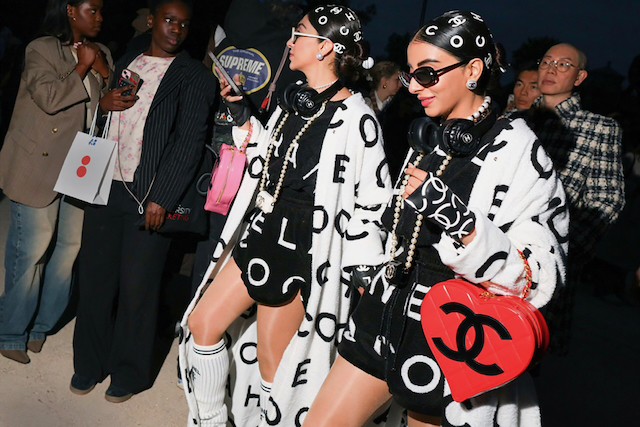
Status, beautifully choreographed. Fashion has always been part clothing, part performance, and entirely more interesting because of it.
The Attention Economy
Social media has industrialized this entire process. We are now observed continuously—every meal, every vacation, every purchase, every opinion, every morning coffee. The observer never leaves the room.
Naturally, the particles become increasingly elaborate.
Luxury marketing understands this better than almost anyone. It isn't really selling handbags; it's selling the feeling of existing more vividly inside somebody else's imagination. You don't buy visibility so much as the hope that someone else's observation will complete the version of yourself you've been assembling.
Today's buzzword is the attention economy, but perhaps that's simply another name for the oldest economy of all: the economy of being seen.
Luxury as Performance
None of this means there is anything wrong with luxury. There is nothing wrong with beautiful clothes, nothing wrong with craftsmanship, nothing wrong with loving fashion, collecting watches, or appreciating a perfectly designed object. Humans have always decorated themselves; we painted caves long before we built shopping malls.
The interesting question is not what we wear, but who is wearing it. Is it an expression of ourselves, or is it a costume for the observer?
There is a subtle but profound difference between having style and performing status. One feels playful, the other feels strangely exhausting.
The problem begins when the Porsche starts driving you.
Perhaps that is why luxury occasionally starts feeling heavy—not because the objects weigh more, but because the identity attached to them does.
Returning to the Wave
Spiritual teachers have been making the opposite argument for centuries. Eckhart Tolle writes about Presence, the awareness that exists before the ego begins performing for the world. Michael Singer calls it the personal self. Alan Watts delighted in laughing at the endless performance of the ego. Years ago, Stuart Wilde introduced a metaphor that immediately opened my eyes, suggesting that humanity spends much of its time collapsing itself into fixed identities, forgetting that our natural state may be something far more fluid.
Different vocabulary, remarkably similar destination.
The less obsessed we become with being observed, the more peaceful life becomes. Perhaps enlightenment is simply returning to the wave—not disappearing, not withdrawing from society, but no longer requiring every room to confirm who you are.
Quiet Luxury
Ironically, the genuinely rich often seem the least interested in looking rich. Fashion now calls it quiet luxury, but perhaps quiet luxury is simply what confidence looks like. The absence of ego doesn't mean becoming blind to beauty; quite the opposite, it makes us more sensitive to beauty that doesn't need applause.
A beautifully cut jacket, a perfectly made chair, a Japanese teacup, a forest after the rain, a sunset that has never checked Instagram—beauty doesn't disappear. Performance does.
Quiet confidence rarely needs a logo.
Which raises an uncomfortable possibility: maybe luxury was never the expensive object at all. Maybe the real luxury is existing without constantly collapsing into somebody else's expectations.
That doesn't require a Birkin. It only requires remembering that we were waves long before we became particles.
And perhaps that is the greatest irony of all: the more desperately we try to be seen, the less we actually see.
The moment we stop performing for the observer, style becomes play again, fashion becomes creativity again, and luxury quietly returns to what it always had the potential to be—not a proof of who we are, but just another beautiful thing in the room.