
TOO LUXURIOUS TO LIVE
Luxury spent decades manufacturing scarcity. Sometimes the final production step was destroying what it had already made. Now the law is asking an unexpectedly philosophical question: if a perfectly good Chanel bag already exists, who gets to decide that it shouldn’t?
The Bag, the Thief and the Shredder
Some crimes are against fashion; others involve fashion.
Four former Chanel warehouse employees in Hong Kong recently received prison sentences ranging from four to seven years for stealing hundreds of Chanel handbags and wallets. The schemes dated back to 2016 and 2017, and the goods were worth millions of Hong Kong dollars.
So far, nothing particularly philosophical. People stole expensive handbags. People got caught. People went to prison. Crime, punishment, quilted calfskin.
Except for one exquisite detail. Chanel didn’t want the bags. They were waiting to be destroyed.
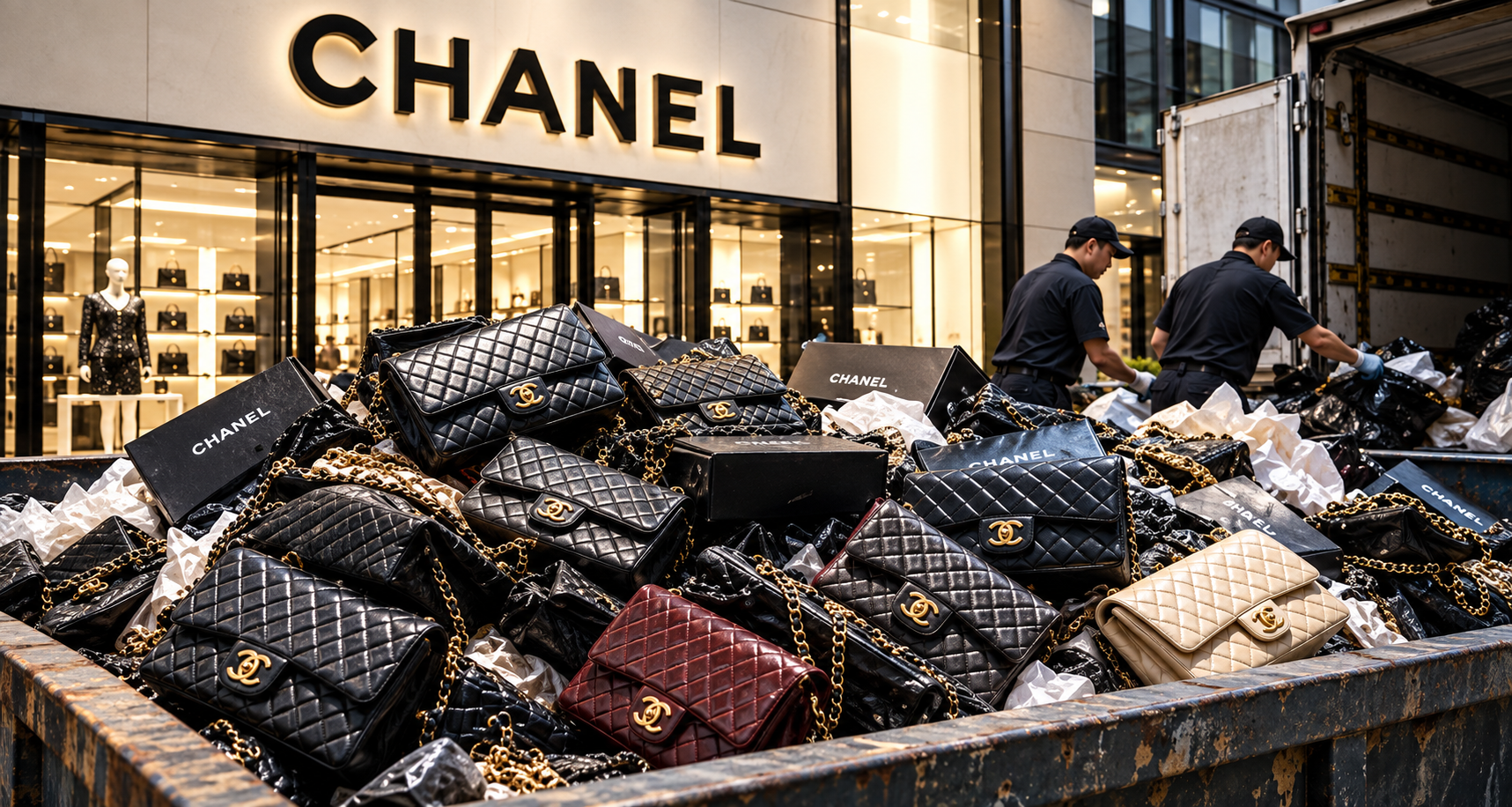
Millions in luxury, headed for the shredder. Steal them and suddenly they’re valuable again.
According to evidence presented during the proceedings, Chanel Hong Kong had historically been destroying somewhere between 10,000 and 20,000 outdated luxury items approximately every six months. The unwanted merchandise was unpacked and mechanically shredded.
The thieves apparently had another recycling proposal.
They intended to sell it.
This was illegal, of course. Stealing remains stealing even when the victim is standing beside a shredder. The employees weren’t environmental activists staging an intervention for endangered handbags. They wanted money.
But ethically, economically and philosophically, something magnificent happens the moment they remove the condemned bags from the warehouse.
The bags become valuable again.
THE MIRACULOUS RESURRECTION OF VALUE
Consider the journey of one hypothetical Chanel bag.
It begins life as an expensive luxury object. Leather is selected, hardware attached, craftsmanship applied, branding added, marketing performed. It enters the world carrying a retail price capable of financing a respectable holiday.
Then nobody buys it.
Eventually Chanel decides it is obsolete.
For practical purposes, its commercial value becomes zero. Worse than zero, actually. The bag has become a liability. Allow it into the wrong market at the wrong price and it might interfere with the carefully maintained value of all the Chanel bags successfully sold at the right price.
So the bag is sentenced to death.
Then somebody steals it.
Suddenly everybody remembers that it is valuable.
Police become involved. Lawyers become involved. Courts become involved. Retail valuations appear. Prison sentences follow.
The object that was too worthless to sell has become too valuable to steal.
And after the authorities recovered the goods?
They were reportedly destroyed.
Order restored.
There is something almost reassuring about the consistency.
SCARCITY, NOW AVAILABLE IN INDUSTRIAL QUANTITIES
Luxury has always depended partly on scarcity. There is nothing inherently sinister about that.
A master craftsperson can make only so many objects. Rare materials are rare. Complicated things take time. A small atelier cannot produce ten million handbags simply because quarterly earnings would find the experience invigorating.
That is organic scarcity.
Modern luxury discovered something more ambitious.
Massive global corporations wanted scarcity and growth simultaneously.
This presents a small mathematical inconvenience.
If you need to sell more things every year, you generally need to make more things. If you make more things, there are more things. If there are more things, the things become less scarce.
Luxury’s solution was ingenious.
Make more things, then carefully control where all those things are allowed to exist.
Scarcity became an administrative achievement.
Waiting lists, allocations, controlled distribution, discreet outlet strategies, hostility toward grey markets, aggressive trademark protection and, historically, when necessary, destruction all helped maintain the illusion that abundance had somehow remained exclusive.
The shredder wasn’t the failure of the luxury system.
The shredder was part of the system.
It was marketing’s basement.
BURBERRY DISCOVERS FIRE
Chanel was hardly alone.
In 2018, Burberry became the poster child for luxury destruction after revealing that it had destroyed £28.6 million worth of finished goods during the previous financial year.
The public reacted with the curious belief that manufacturing perfectly good products and then destroying them might be wasteful.
Burberry subsequently announced that it would stop destroying unsaleable finished products.
Progress.
Richemont, owner of Cartier and other prestigious watch houses, faced a slightly different version of the same problem. During a period of excess inventory, the group bought back hundreds of millions of euros worth of watches from retailers, partly to prevent them appearing on the grey market at discounts. Many were dismantled and their components recycled.
Again, the problem wasn’t necessarily that the products had become physically defective.
The problem was that they might become cheap.
And a cheap authentic luxury product can be considerably more dangerous to a luxury company than a destroyed luxury product.
A counterfeit says: I want what you make.
A discounted authentic product says: Perhaps what you make isn’t worth what you said.
No wonder one requires lawyers and the other occasionally required machinery.
THE LOGO SURVIVES THE BAG
What exactly is being protected when a perfectly functional luxury product is destroyed?
Not the leather. The leather is about to have an unfortunate afternoon.
Not the craftsmanship. That disappears with it.
Not the utility of the object. Nobody doubts that the handbag remains capable of the technologically demanding task of carrying things.
What survives is the abstraction.
CHANEL.
The physical Chanel bag can be sacrificed to preserve the metaphysical Chanel.
That may be the purest expression of modern luxury economics imaginable. The object exists to support the symbol until its existence threatens the symbol, at which point the object must go.
Oscar Wilde would surely have appreciated the arrangement. We have finally created a society in which appearances are not merely more important than reality. Reality can be mechanically shredded when it becomes inconvenient to appearances.
THE EUROPEAN UNION ENTERS THE WAREHOUSE
Unfortunately for the shredder, regulators have arrived.
Under the European Union’s Ecodesign for Sustainable Products Regulation, large companies have been prohibited since July 19, 2026 from destroying certain categories of unsold apparel, clothing accessories and footwear, subject to specified exemptions. Medium-sized companies are scheduled to follow later.
The legislation contains a surprisingly interesting idea.
Recycling isn’t necessarily good enough.
For years, corporate sustainability has trained us to hear the word recycling and applaud before asking what actually happened.
But consider the handbag again.
It is finished. It works. It is already a handbag.
Recycling a perfectly good handbag because you produced too many handbags is an extraordinarily complicated way of avoiding the simpler conclusion that perhaps you produced too many handbags.
Grinding an object back into materials isn’t circularity’s greatest triumph when the circle could simply have remained a bag.
PLEASE DO NOT RESCUE THE HANDBAG
None of this absolves the thieves. They were stealing for profit, not liberating political prisoners from a Chanel warehouse.
But remove intention for a moment and the physical sequence becomes wonderfully strange.
One party possesses a perfectly functional object and intends to destroy it. Another removes the object and intends to return it to commercial use.
The second party has committed the crime.
The first has protected the brand.
Property law makes this perfectly understandable. Environmental ethics makes it considerably less comfortable.
The leather didn’t simply “come from somewhere.” An animal died. Its skin was processed, dyed, cut and stitched into a handbag. Metal was mined and manufactured. Water and energy were consumed. People made the bag, transported it, stored it and marketed it. Land, carbon, labor, materials and, in the case of leather, animal life have already been transformed into an object.
Whatever one thinks about using animals for leather, destroying the finished object adds a particularly grotesque final flourish: the animal died for something deliberately manufactured, only for the manufacturer to decide that the object itself must now die too.
All that extraction, life, labor and energy, not because the bag failed, but because it failed to sell at the desired price.
At that point, the shredder isn’t merely destroying inventory.
It is destroying everything that went into making the inventory.
Can ownership morally include the unlimited right to erase all of that embodied value merely to maintain the price of other objects?
Legally, historically, often yes.
Ethically?
Welcome to luxury.
THE SECONDHAND HERESY
There is another reason this story matters now.
Resale has destroyed the fantasy that luxury brands completely control the lives of their products.
A handbag once had a relatively straightforward commercial biography: brand, boutique, customer. The brand controlled the first two stages and then politely stopped looking.
Now the bag may travel through five owners, three countries, two resale platforms and an authentication center before appearing on Instagram attached to someone born after it was manufactured.
The object has acquired an afterlife.
That is economically awkward for an industry built around selling new objects, but philosophically rather wonderful.
Because resale introduces a radical proposition:
The object may have value independent of the brand’s desire to sell another object.
That sounds obvious until you realize how much of modern consumer capitalism depends upon us forgetting it.
A well-made handbag can remain a well-made handbag for decades.
Which raises an uncomfortable possibility.
Perhaps the most sustainable luxury product isn’t the recyclable one.
Perhaps it is the one that stubbornly refuses to become waste.
THE GREAT LUXURY CONTRADICTION
This is where the handbag becomes considerably larger than a handbag.
The luxury conglomerate wants growth while luxury wants scarcity. The conglomerate wants more customers while luxury wants exclusivity. The conglomerate wants increasing production while luxury wants rarity. The conglomerate wants quarterly performance while luxury wants timelessness.
Eventually those contradictions stop being marketing language and become physical inventory.
Somewhere, somebody has to reconcile the poetry with the spreadsheet.
For a while, the shredder helped.
You could manufacture abundance upstream and manufacture scarcity downstream. Produce 120, sell 100, eliminate 20 and return to the boardroom with the reassuring conviction that the world contains only 100.
Voilà.
Limited edition.
Scarcity with an eraser.
WHAT IF LUXURY TRIED LUXURY?
There is, inconveniently, another solution.
Make fewer things.
This is unlikely to electrify the investor presentation.
But imagine luxury built around genuinely limited production, made-to-order manufacturing, repair, restoration, authenticated resale, archive programs, remanufacturing and objects designed to survive several owners.
Not sustainability as penance.
Luxury as longevity.
Not producing 20,000 objects too many and then commissioning a circular-economy strategy to determine what sophisticated industrial process should happen to them.
Just don’t make the 20,000.
The irony is almost painful.
After decades of expansion, financialization and industrial scaling, environmental regulation may eventually force luxury to rediscover the characteristics that originally made something luxurious: rarity, craft, longevity, care and things worth keeping.
This would require accepting slower growth, smaller volumes and the terrifying possibility that an excellent handbag sold twenty years ago might still satisfy somebody today.
Don’t worry.
We aren’t expecting miracles.
THE RIGHT TO DESTROY
And so we return to our condemned Chanel bag.
It exists. Someone made it. Someone wants it. The company doesn’t want to sell it. Someone takes it. The law says the taking is wrong. The company destroys it.
For property law, there is little mystery. The bag belongs to Chanel. You cannot steal somebody else’s property simply because you disagree with what they intend to do with it.
But ethics is rarely considerate enough to stop where law stops.
If an object has already consumed materials, labor and environmental resources, and another human being wants to use it, does ownership confer an unlimited moral right to destroy it solely to protect the price of other objects?
And if society increasingly decides that the answer is no, something rather profound has changed.
We are no longer arguing about recycling.
We are asking whether manufactured objects acquire, through the resources embodied in them, a claim against pointless destruction.
That question travels far beyond handbags.
Luxury merely makes the absurdity easier to see because it attaches enormous monetary value to an object before deciding that the continued existence of the same object threatens its value.
Perhaps that is the final irony of the Chanel case.
The employees treated the unwanted bags as valuable and were sent to prison for it.
Chanel treated them as worthless and was protecting their value.
The bags were recovered.
The bags were destroyed.
The brand survived.
Naturally.
It was the only thing in the warehouse that was never in any danger.